
How to be a bestselling author with Anna Funder
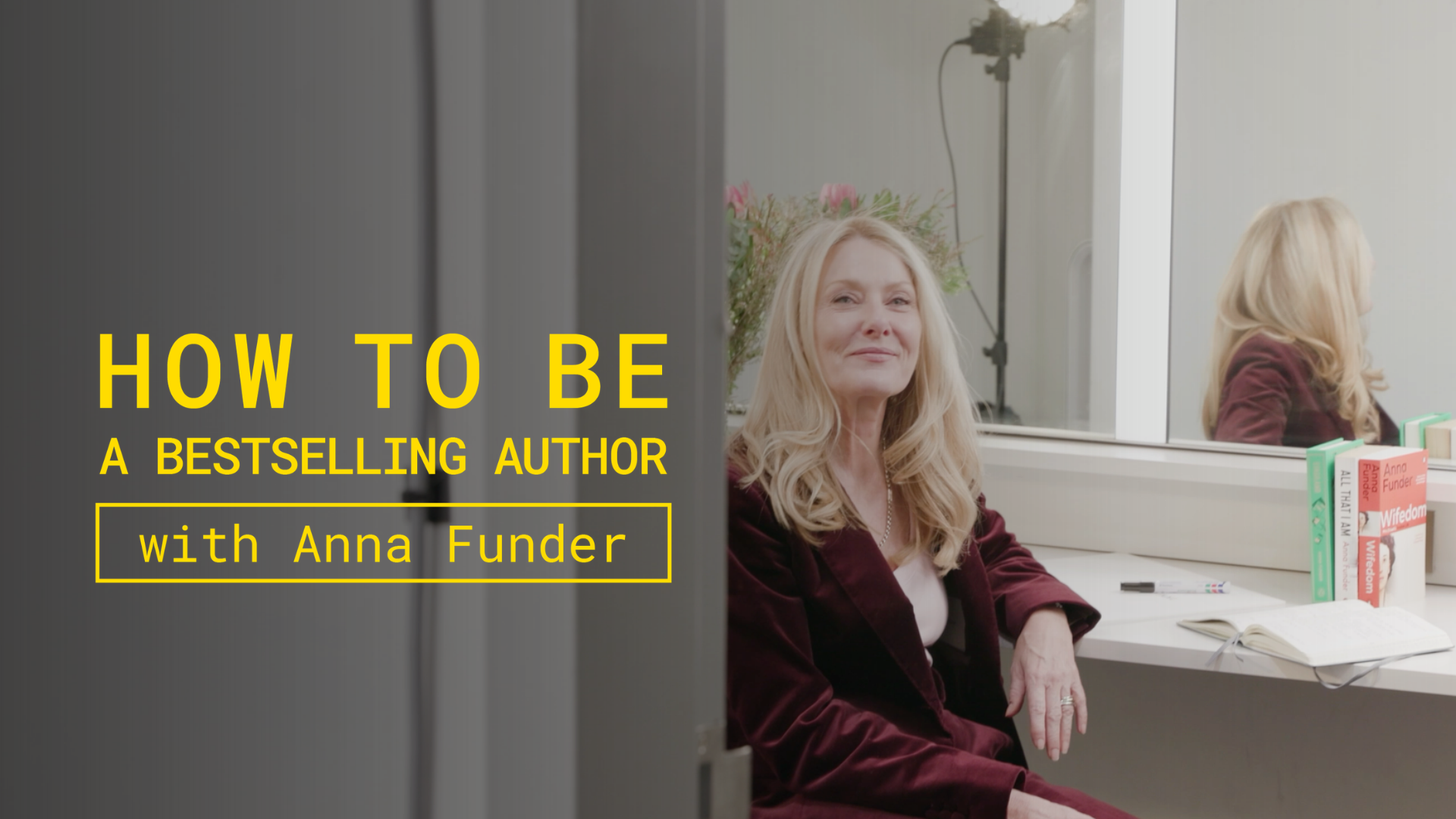
You have to be as honest as you can, knowing that whatever truth you're capturing on the page, your life will go on and every reader is different. And so you have to just try and get it right so that you're honouring the people in it, even though your view of that might change.


In 1997, Anna Funder left Australia for Berlin. She told everyone that she was leaving to write a book, and now the pressure was on to deliver. Six years later Anna published Stasiland, stories gathered about life in East Germany from the people she interviewed during her time in Berlin.
Stasiland would go onto to win the Samuel Johnson Prize, be translated into a dozen languages and taught in Australian classrooms. Anna's work centres on untold stories of women whose pivotal role in history has either been brushed aside or concealed.
In the 23 years since her first book was published, Anna has written two more highly prized books: All That I Am and Wifedom, which was named a NYTimes notable book of the year.
Award-winning, internationally acclaimed writer Anna Funder shares How to be a best-selling author. Tune in to hear Anna’s advice for first-time writers, how she comes up with her original story ideas and how she deftly tows the line between truth and fiction.
Transcript
UNSW Centre for Ideas: UNSW Centre for Ideas
In 1997, Anna Funder left Australia for Berlin. She left her career in law, her boyfriend and the life she'd built for herself. She told everyone that she was leaving to write a book, and now the pressure was on to deliver.
Six years later, Anna would publish Stasiland, stories gathered about life in East Germany from the people she interviewed during her time in Berlin. Stasiland would go on to win the Samuel Johnson Prize, be translated into a dozen languages, and taught in Australian classrooms. In the 23 years since her first book was published, Anna has written two more highly prized books, All That I Am and Wifedom, which was named a New York Times Notable Book of the Year.
Averaging at one critically acclaimed classic a decade, it's a pretty good wicket. Anna's work centres on untold stories of women whose pivotal role in history has either been brushed aside or concealed. Her specialty is holding real human beings up to the light and examining them for all their features, their virtues and their flaws.
On this episode, Anna Funder shares what the life of a writer is like, and her advice for How to be a Best-Selling Novelist.
Anna Funder: I would say that one thing an author always needs to have with them is a notebook because you have a thought and you think, that's okay, I will remember that, and if you're me, you won't. So this is my notebook, I love these, I have, this is my new kind of passion over the last few years. And the last thing I wrote in here was Baldwin dash innocence, which might not mean anything to anybody but it means something to me.
A creative prompt for the audience, I would say pick some random thing in your day and give it a paragraph because almost anything is interesting once you start looking at it closely. So it could be, you know, what I did in Baker's Delight. Well, I think that the AI companies are running a narrative that everything is a done deal and everything is going to be done their way.
So their theft of creative work, for instance, that's happened on an industrialised global scale, the theft and destruction of many books, many millions of them. It's as if, well, we've done that and we've gotten away with it to train quote unquote, our machines. And therefore it's inevitable as it's going to roll out, it's not inevitable and they're going to need to be regulated and authors are going to need to be compensated.
I don't know that there's such a thing as a good author in the same way as, you know, there are good people and there are some people who are better than others or less good or I'm not sure that it's helpful to be good if you're an author. I think authors often have insight into quite difficult things in life. And so we are writing light and dark.
I think what happens for a reader is that you, this is what I found writing my Orwell book, for instance, Wifedom, we read a book and we love the book. And so we transfer the love for this art object, this beautiful book onto the author. We think this author must also be worthy of my love.
I want to love the author because I love his or her book so much. But really, you know, the author Richard Ford said this better than I can. He said it beautifully.
He said, "I think readers are always disappointed when they meet me because I put my best self into my work and I am not my best self". And I would go further. I would just say that it's important for authors to be able to show dark things between the pages.
That's what we want. We want this safe encounter with things that are beautiful and wonderful and light, but also things that are dark and difficult so we can manage them. So we get a kind of Aristotelian catharsis from reading.
And I don't think in the case of Orwell, who was a very complicated, in some ways, dark, sadistic, deeply unfaithful man, those complexities, he's writing out of those, whether he knows it or not. So his paranoid vision in 1984, some of his insights are definitely coming from his sense of not being quite decent enough. And that's important.
We wouldn't have the great works without the difficult man. So I think, also speaking as a deeply flawed human, I just think it's too much to expect writers also to be good people. It's fine to have the dream as a reader, but maybe never meet your heroes.
Honesty is very important. I think trying to get to the truth of something for me is very important. And as I'm getting older and I look back on my books, they change for me.
For instance, there's a character in Stasiland called Frau Paul, whose baby gets left in a hospital on the wrong side of the wall when the wall goes up overnight, the Berlin Wall. So this very sick, eight-month-old baby is being treated in a hospital in the western part of Berlin. She's in the east and she can't get to him.
And she is eventually taken into Stasi interrogation and custody. And she is offered a deal to go and see her baby, which can be done if she betrays someone. And she refuses to betray this person.
So her baby grows up in a West German hospital ward for six years and she goes to prison. So when I wrote that, I was writing that as honestly as I possibly could as a 30-year-old or in my early 30s, before I had children. And I thought that I was really doing justice to that story.
And I was being as absolutely truthful and honest as I could. But now when I read that and I have children, my view of that has changed. So what's on the page, I would not change.
It's as truthful and honest as it could be. And at the time, I thought that was an unbelievably brave decision and a terrible Sophie's choice to have to make and so on. But now I read it differently because I think had that been my baby, I would have gone to my baby and I would probably have sacrificed the adult who was trying to help me escape.
I think probably. So you have to be as honest as you can, knowing that whatever truth you're capturing on the page, your life will go on and every reader is different. And so you have to just try and get it right so that you're honouring the people in it, even though your view of that might change.
Bravery and courage are very interesting to me. I think that the courage of ordinary people in, say, Stasiland who are making these extraordinary brave and moral decisions not to betray everyone around them to the Stasi, knowing it would probably wreck their lives. That is a very interesting thing about human beings.
There are many, many human beings who will do these kinds of things. We are hardwired to live in groups, to communicate, to have empathy and to look after one another. And we see that in these extraordinary acts of bravery and conscience.
And that really interests me. That goes against the tenor of our times, where we see a kind of neo-fascist might is right, tech bro culture, where everything is there to be taken and stolen. We are all surveyed, our privacy and data has been mined, our attention and dopamine mined as well.
So I think we need to concentrate on what it is to be, as you said before, a good person, but also to stick up for the values that we have as individuals. And I think it will make a big difference. I think we have to say empathy is key.
It is not, as Elon Musk says, the bug in Western civilisation. It's what's going to keep us strong. So I am interested in bravery.
I don't feel particularly brave. I am not particularly brave. I know most people I know are probably braver than I am.
I just feel if you're going to say something, get it right and say it, say it loud. I have loved so many things this year. I've read so many wonderful books.
I absolutely adored Elizabeth Strout's latest book, The Things We Never Say, which is essentially about a man, a very decent man, to use an Orwellian term, a very good-hearted, decent man who's a history teacher trying to stay decent and caring in Trump world, basically. And it has the most extraordinary moments of human connection and compassion in it. I really loved it.
I also have loved Fiona McFarlane's Highway 13. She's an Australian writer who teaches in California now. And it is a brilliant ensemble set of stories, vaguely connected by their connection to a serial killer like Ivan Milat in the 90s, in the Belanglo forest, 80s and 90s.
And it's done with a very light touch and the serial killer himself nor his deeds get no airtime, which is a fantastic, to my mind, aesthetic and moral decision. We will give this evil no airtime, but we will look at the effects in this kind of ripples on a pond way. I absolutely love that.
There's a Canadian writer that I have adored discovering very late. I love it when you make a late discovery. It's like your ignorance, like the deeper your ignorance is, the more there is that you're, that's coming up for you.
A woman called Miriam Toews, which is spelled T-O-E-W-S. And she is a beautiful Canadian writer. And I've been devouring all her work, memoir and novels.
Artistry is immense. And I think that those writers have an ability to focus on moments of deep human connection, but also everyday human connection in ways that we might not notice in our normal lives. And I think that's really lovely.
It wakens you up in your everyday life. I came into this building, you know, the security guard said to me, "Hello, Anna". I was like, you know, there are moments of human recognition that come.
That's a very, very obvious example. But those writers are very good at harmonium on emotion and connection. And I like that a lot.
I'm a morning writer. So I like to write in the morning. That's when my brain is working best.
So I really don't leave the house. I have coffee or I don't function. I like to move essentially from the bedroom to the coffee machine to my study.
I work in my pyjamas and boots. And I don't really like talking to people much before that happens. There's a sense of freedom.
It's as if you are catching the day before the day can get you with all its other demands. So I try not to make any meetings for the morning. I try not to have anything on and just see what happens.
Sometimes I know what's going to happen. I will have left one of my great mentors told me and I've never forgotten, leave a hook in what you were doing the day before, i.e. leave almost like a paragraph, if not a sentence unfinished that you know where it's going. And that's your hook to start the next day.
And what that does is give you a freedom to start because you know that you are going to be re-anchored into that work. So you know that you're going to make it back in and it gives you then the freedom to not know where you're going. So each day can bring something a little unexpected.
I go till I can't go anymore. I have found with experience that if I go beyond where it feels like I'm doing anything useful, it actually feels harmful. It feels like I'm going through the motions or possibly giving something form that is a good idea but the form I'm giving it is not worthy of the idea and I should just stop and wait until I'm fully slept and re-caffeinated and start again.
There's a sort of almost physicality to it. It's almost like I'm a very amateur weight. I do weights in a very amateur way and I know it works better if you do it and then have a 30 second or minute break.
It's a little bit like that in a bigger scheme of things. You have to break or you might be doing damage. It depends.
Some people really are morning people. I think probably more than others but some people are really night people. I think the sense that you have a space that will not be interrupted, that is just yours and no one is going to ask you anything and actually nothing is expected of you is really great feeling and whether that happens between 5 and 7 in the morning or 5:30 and 6:30 even if it's an hour, an hour and a half is quite a bit of time, you can do a lot or whether it happens late at night, it doesn't matter. Just that sense that I'm going to make a space in which I don't know if anything will happen but anything could and I will not be disturbed is really important and I would start, even like physical training, I would start relatively, if people are at the beginning, relatively short, you know maximum an hour, see what happens. The first thing I would do if I started it all again, it's like going back to meet your younger self and tell her all the things she did wrong, so many, I don't know how long you've got.
I think one of the most important things about writing is the confidence to do it. That is something that is not necessarily innate and it's not necessarily a given, it's not like there are some writers who are confident and some who aren't. I think it comes in the doing, so I would tell my younger self just do it and how bad can it be, you know, at least there'll be something on the page, just do it and keep going.
I've had long periods where, long seems long to me, periods where I haven't loved what I've been working on and those decisions are really hard, whether to leave something once you have a certain amount of words invested in it and time invested in it. I think I knew what to leave and when to leave it but possibly I would tell my younger self go earlier, yeah.
I talk about my work a lot with my husband who's very patient with me and he's also very, he's an architect so he's very structural, so with All That I Am for instance, where I mean my, one of my main aims is that whatever I write can be essentially inhaled, so the reader is not noticing technique, they're not noticing craft, they're not noticing anything, I really would like it to be inhaled in a kind of urgent page turnery way, not that I'm writing kind of your classic page turner, but the structures that I have found that have suited the truths that I have been telling have been a little more complicated.
So All That I Am, I'm telling the story of a woman who dies two-thirds of the way through the book, so but I need to keep telling that story and she's real and I wanted to tell it with two intimate points of view on her, one is Ruth's point of view and one is Toller's point of view, so Toller is telling the story in 1939 in a hotel room in New York and Ruth is telling the story as an old woman in Sydney in the late 90s, 2000, so you've got these two points of view on the one set of actions in London among these anti-Hitler activists in 1935, two people who love Dora and then you're coming in and out of the same action.
And I can remember talking about this with Craig saying, “This is going to kill me, this is going to completely kill me,” and also the suspicion that if something feels difficult it's going to be difficult for the reader and that's absolutely against my inhaling principles, so he got out this huge bit of butcher's paper and laid it down and first of all he says to me, “This is easy,” which is both encouraging and annoying.
This is easy, when I've been struggling with it and has the narrative of the the core story and then has Toller coming in, Ruth coming in so that each of them are adding in sequence to that, so yeah I talk to him and he helps me a lot but basically I don't talk to many people about what I'm doing mainly because in that early morning time I want to be able to turn up and anything can happen and if I have already explained to my friends at dinner that I am writing a novel about x y and z I am telling my subconscious that I am writing a novel about x y and z and in my experience the real gold that comes in the writing of all the books comes unexpectedly and I don't want to tell my subconscious that this is what she has to do. A, she won't do it she'll jack up, and b, I want to leave open the possibility to be surprised.
So All That I Am for instance, the scene that that absolutely propels the narrative is Ruth having as an old woman an accident on New South Head Road, not so far from here, I can remember turning up I had a tiny windowless cubicle at the university that I was working in as a doctoral student and I can remember not knowing that that was going to happen and leaving at the end of that working day which was probably you know to get kids from creche in the afternoon and being very surprised that that scene had happened and that scene is completely key to the book so I don't tell, I don't talk about things a lot as they're going just to leave open the possibility that possibly I will surprise myself.
It wasn't ever clear to me as a way of operating that I was looking for untold stories, I think really until I have had to talk about the books in a in a kind of series that I saw that connection, stories that have been untold, stories that I am finding for the first time like the stories of the four really courageous people in Stasiland or the stories of Dora and Matilda and Toller in All That I Am or indeed Eileen O'Shaughnessy Orwell's First Wife's story, they are all untold and I'm not sure that that's what's so exciting about them except that it is because these are stories of extraordinary people.
It is bizarre that they are not well known, the first very brave anti-Hitler activists who go to London and tell Churchill exactly what Hitler's up to and the world isn't listening, why don't we know about these people who paid with their lives to do something to try and save the rest of us, why don't we know? When I was writing Stasiland I was writing at the very same time that the people that I was writing about were living and walking around in Leipzig and Dresden and Berlin and so were their former interrogators and Stasi men which accounts for why those stories weren't being told there, you know there was a lot of threat to those people from ex-Stasi for talking.
So when you're looking at stories of people that haven't been told, one they're often very exciting extraordinary stories that's just what appeals to me, I'm not looking for the untold story but what you get by way of bonus is not just the story of that person but you have to confront then what are the forces that are operating in society against this story being told and they are very interesting, they are very interesting.
So in Stasiland in the 90s the sort of ideology was East and West are going to get back together, we're all friends now, it's all fine but the only way everything can be all fine after such a terrible regime like in East Germany is if the are not honoured because if you pretend there were no victims there are also no perpetrators and then we can all get along. So that was what was happening, I didn't quite register that that was what was happening and when the book came out in Germany I thought it would be much more celebrated than it turned out to be, I mean it's a very well-known book but it is a difficult book for Germans.
All That I Am, it's a long way past the fascist regime in Germany so there was no sort of pushback but essentially that's a book about the price of appeasement politics in London that those women paid. And to look at Eileen O'Shaughnessy's story and the way that six biographers of Orwell have utterly written her out of history when she was really the woman who made Orwell the writer that he was is to confront the methods of patriarchy that make women small or leave them out of the picture entirely in order that it looks like men or in this case a writer did everything by himself.
I think that in heterosexual marriages today the work of love and life and care is still even in a country as rich and as fair as Australia very unequally distributed so we have a gendered view of that work and it attaches to women. I can give you an example of how that works, even at the level of language you can't be a good woman, a good mother or a good wife without doing the work of care for others that those definitions entail but you can absolutely be a good bloke and not do any nappy changing or medical appointments or Christmas organising or all the other work that keeps the generations going.
You can just buy your round at the pub, keep your word, not cheat at cards and you're a decent bloke.
So no work attaches to being a good man and I think that we see the results of this obviously in a gender pay gap that still exists, in men being disproportionately represented at the heads of corporations and in government everywhere. So patriarchy is alive and well and Eileen in Orwell's marriage is a very, in some ways extreme and in some ways typical example of how that power dynamic works and because she was raised by biographers coming right up to the present day, male biographers, we see it still at work today.
So they will write her out of history by not, by using the passive voice for instance and saying the manuscript was typed, Orwell does this, the visas were obtained, you know, the hotel was booked, whatever it is. So things are done without doers when they're women. I haven't read very many books about writing.
When I do I love it, I feel sort of consoled and in good company but I didn't train myself on those sorts of books. There were writers who were very important to me when I was in my late teens and early 20s which was a really formative time as a writer and I was particularly always blown away by Granta which is a British publication. It's slightly different now but when I was younger it seemed absolutely magical and it featured writers like Bruce Chapman and Richard Kapuscinski.
Richard Kapuscinski was a Polish foreign correspondent who was allowed out from Poland behind the Iron Curtain to report on the world. So Ryszard Kapuscinski and Bruce Chapman were writing non-fiction that read like fiction and for me that was a kind of magic and I think that I, my work in Stasiland is very different. It's a female point of view and also I didn't allow myself the kind of liberties that they allowed themselves.
It's now, you know, they were a little bit fast and loose with the truth, I'm pretty exact as I can be but they were very important to me. Yes and no, Kapuscinski and Chapman laying the groundwork for how I do that. I mean I really enjoyed them and I was mesmerised by their writing.
Kapuscinski and Chapman and also apparently Oliver Sacks really are presenting what they're doing as non-fiction when love it or not love it. Some of it is made up or a bit fast and loose with the truth but it's presented as non-fiction. For some people that doesn't matter at all, you're just reading a beautiful text.
For me the legacy of my, I don't know, scientific fan, my truth questing family, my law degree, I don't know what my problem is but for me there is a fundamental contract with a reader which is I think it's important to know if what you're reading is presenting itself as non-fiction, this is true, this all happened or as fiction. The guardrails around that or the judgments that you make as a reader around that or the leap of faith into fiction that you make are different. So I do write non-fiction like Stasiland that reads like fiction but that's because it has a emotional heft to it that is like fiction but everything in it is true.
So I did it not by twisting the facts but by bringing an emotional impetus if you like to the writing itself and to the point of view because I could play with my point of view but I couldn't play with what anybody else said to me. So I can play with the reaction shot if you like but I can't go into someone else's consciousness. In the novel All That I Am, I can totally go into someone else's consciousness because they're dead or the people that these characters are based on and I want them to live again.
So that was a different thing and in Wifedom which as you would point out is a mixture of non-fiction writing and fiction writing, it's very clearly signposted when we're going into fiction. So it is the margins, I mean physically set narrower in the book. I wanted people to be aware that these are scenes, I'm using Eileen's letters but I am imagining myself into her head as she writes them, it was really important.
I've noticed a lot of readers who don't care at all, they are much to my delight just inhaling the whole thing and it doesn't matter to them whether they're in a zone of truth-telling with you know the 400 footnotes that are in that book or not to be scary about it or if they're in a zone of fiction they don't they don't care. So the experience can be the same but for some people like me it matters if something's presented as truth or fiction. I have to say there's another reason why it's really important.
I would have written Stasiland as a novel and I tried to and it was no good and there are a bunch of reasons for that but one of them is that a novel has to be believable. You are establishing a kind of contract to use that word again with the reader that says come with me you're in safe hands I'm going to set up within as quickly as I can within 10 or 20 pages a world in which you believe that you know the parameters of this is realist fiction this is fantasy fiction this is whatever it is but there are rules in non-fiction but I could not have created a believable world of East Germany in fiction that actually bore witness to that world. The world of East Germany was too extreme and too unbelievable for fiction it would have stretched credibility in a novel to have Stasi men climbing into your flat when you're not there stealing your dirty underwear sticking it in a jar training a dog to track you. You know a reader might say she's gone too far so in order to bear witness to what happened to that regime and so also to the courage of the people who were rebelling against it I had to make it non-fiction because it's not it's not believable the courage of the people is barely believable and the perfidy of the regime so in a way the choice of fiction or non-fiction depends on the truths that you're trying to tell. Are the people still alive? Are their stories not being told?
I could go into Eileen's head in Wifedom because she's gone hopefully she doesn't mind. Do you know I don't know whether I ever decided to become a writer I think I thought that I was even before I was doing anything it was like a recognition of something that you are even as a child I thought this is what I need to do this is how I'm going to be but I didn't publish till I was you know in my early 30s so I I felt that I had done what I was meant to do when I did that first book but I've never had any sense of a career I think there's so much that you can't control. I felt lucky to be published I felt lucky that the book got the attention that it got everything is it's very hard to plan a creative life you know you don't know what's going to happen to you you don't know what the next page is going to be what the next book is going to be what the reception of the book is going to be I'm just happy I've been able to keep doing it.