How to be a renowned creative with Andrew Upton
What does storytelling give us? ...Everything. I think solutions. Comfort for the problems that we can't solve.


Andrew Upton is a man of many talents. He has written for theatre, film and television in Australia and abroad, and his stage adaptations have toured internationally. Alongside his wife, Cate Blanchett, he has championed making art accessible. As educators and environmentalists, they channeled their passion for theatre, sustainability and teaching into an award-winning green performing arts hub when Co-Directors of the Sydney Theatre Company.
Most recently, Andrew published his debut novel, Krank Fuss, a bold fable akin to George Orwell’s Animal Farm, following a chicken with a deformed foot. Set on a German farm on the eve of World War II, this timely story reminds us to hope even under the creeping shadow of fascism.
Across his many artistic pursuits, storytelling has been Andrew’s true calling, a master of when and how a story should be told. On this episode, Andrew Upton shares his advice for How to be a renowned creative. Tune in to hear his advice for crafting compelling stories, picking the right medium to tell a story and what he wishes he’d done more as an eighteen-year-old.
Transcript
Centre for Ideas: You’re Listening to the UNSW Centre for Ideas
Andrew Upton is a man of many talents. He has written for theatre, film and television in Australia and abroad, and his stage adaptations have toured internationally. Alongside his wife, Cate Blanchett, he has championed making art accessible. As educators and environmentalists, they channeled their passion for theatre, sustainability and teaching into an award-winning green performing arts hub when Co-Directors of the Sydney Theatre Company.
Most recently, Andrew published his debut novel, Krank Fuss, a bold fable akin to George Orwell’s Animal Farm, following a chicken with a deformed foot. Set on a German farm on the eve of World War II, this timely story reminds us to hope even under the creeping shadow of fascism.
Across his many artistic pursuits, storytelling has been Andrew’s true calling, a master of when and how a story should be told.
On this episode, Andrew Upton shares his advice for How to be a renowned creative.
Andrew Upton:
Seeing something that I had written on stage for the first time, it happened actually when I was quite young, I was about 18, and there was this thing called the Young Playwrights Conference, the shopfront theatre for young people, and I'd written a play, and for some reason, known only to them, they did a production of it. And I got to see it, I went to see it, I went to see it about four times, of course. Well, that says the first thing, it's unbelievable really, particularly theatre, because you, you know, as I was saying earlier, the voices are in your head, and then when they come alive again in front of you, and I hadn't gone to any rehearsals, which you normally do as a writer, that turns out, but I didn't know that, and they didn't have me.
So I literally was there with an audience, and it was sort of a bit funny, it was a kind of terrible Pinteresque rip-off thing, but people laughing at words that I'd heard in my own head and thought, yeah, I think that's quite funny, or that's quite weird, that's quite, you know, tense. It was fantastic, and it's very addictive, and particularly people laughing for me. I, it's just a joyous moment when you, it's a joyous moment when you write something, you think, that is, I'm sure that's funny, and then when you hear it, and it is, thank God, that's great.
How old were you when that happened? I was 18 when the, the Shopfront production was on, and then I did a few things at university, which of course weren't funny, because they were very serious, which probably made me think, nah, better to be funny, and then there was probably a gap, and I went to art school. I mean, yeah, it probably happened quite a bit. Yeah, I mean, look, it's a thing that you get used to, because there is, it's, it's also, yeah, it's great, satisfying, it's lovely, but it's also excruciating, because it is, it's very, you know, I'm quite reserved, and it's very revealing, um, and you have to hope that it works.
If you had to start all over again tomorrow as an 18-year-old, what would you do, what advice would you give to yourself? To pay more attention, um, to be more rigorous and, and work more slowly, and in more detail. You could just say, if I had to start over again tomorrow. If I had to start over again tomorrow, talking to that 18-year-old, and beyond, probably beyond more, you know, that sort of, that sort of next phase, where I think, I can do this, I can do this. I would say, pay more attention, um, and approach, just approach everything more carefully, and in more detail. Perfect, I think we got it. Thank you very much.
How to be you with Andrew Upton, take one. What must a creative always have on them? I think you do need to have a journal with you at all times. Um, because you, some ideas are quite evanescent, but they keep coming back, but there's a time when they come in, in just the right, if it's a sentence, it can be a sentence, turn of phrase, or the right, you, you finally polish something, and you can forget, and the amount of things I've forgotten. I tell you, I could have written a great book, but I've forgotten most of it. Well, I don't, I, I hate those vocal warmups that actors do actually, they really annoy me. I know they're very important, but the sort of high pitch squealing noises, and the rubbery lips, and what sort of warmup do I like to do before I work? I do like to start the day with exercise, so that is obviously a warmup, but it's not a, it's not a, it's not a theatrical warmup.
I think a creative warmup for me is probably, um, uh, my desk has a very particular untidiness that I know is tidy, and if I'm starting a new project, I clear it, and as things devolve in the project, I have to rearrange it, and I think that is a really strong way of beginning to get my day. I done say paid all the bills, and got the kids to school, or whatever that might be, that those sorts of daily tasks, then this is a way of like putting myself in the right space. I did impulsively purchase a motorbike, um, which I still have and love, um, and it was a bit mad, but it's good, it's nice.
Uh, the book idea came from chickens, which was not an impulsive purchase, it was a, it was a practical restocking of the, of the coop, um, and, uh, I went to get them, pick them up, and, uh, they have a process, I don't, I assume it's the same in Australia, where you just go there with a cardboard box, and you go to the chicken distributing man, and he pulls them out, and in that process, it was, I, they kept going past my face, and every single one of those six of them, look, look me in the eyes, they're definitely thinking something, and they're definitely wondering what the fuck is happening to me, and I quite liked, uh, it left me with a really distinct feeling of this sort of ruption, which I knew, because I was in control of it, was actually not a terrible ruption, but they didn't know that, and I found that, I found that fascinating, actually, a fascinating doorway into, um, I suppose how we come to be, even, in a way, like how you get out of an egg, how you land in the world, how you come to be when you find yourself in this life, and you have to make sense of it. Hold up my least favorite turn of phrase at this point in time, which is quite an old thing now, which is reach out instead of phone, or reach out instead of say hello, or reach out instead of just call. There's a sort of performative bullshit to it that I really don't like.
I had a toy Winnie the Pooh, like, like a teddy bear Winnie the Pooh, and I, I, my father read me Winnie the Pooh. Was it my favorite story? I don't know. I think my, actually, I think my favorite story was The Hobbit, but, because it's a, it really is a story, but there's something about Winnie the Pooh that has stayed with me my whole life.
We were having a Christmas dinner, um, uh, this is about four or five years ago, here in Australia with my family, my brother and sister and their kids, and so there's about, I don't know, 15 of us around the table, uh, and a lot of us were older, you know, like my oldest boy then was 20, and, but my youngest son then would have been about 12, say, and, uh, he asked my sister, who's older than me, what I was like as, when I was his age, what I was like as a child. My sister, who's my oldest sister, uh, said that I was, it's really stayed with me. She said that I was gullible and, which is like insulting on one level, but strangely complimentary on another in, in, to my mind, and it goes to Winnie the Pooh, is that there's a sort of, there's a naivety and an innocence that I think I've always had, and I can't seem to get rid of, and I am gullible, and I am a bit of a fool, but there is a, there's a, I trust the world, and I think there's a beautiful, there's a beautiful, simple trust in the world in Winnie the Pooh.
When we moved back to England, we moved into a county called East Sussex, real, very near where A. A. Milne, uh, wrote, near the Hundred Acre Wood where he wrote, where he set and wrote Winnie the Pooh. But I then heard, and I didn't know this, that A. A. Milne had been in World War I, and he was in, uh, fighting in that awful war, and he moved to East Sussex and, um, wrote Winnie the Pooh, and to me, to find that innocence and that trust in the world and that love for the world after that filthy, disgusting war is one of the great, I think, one of the great acts of human soulfulness. Definitely laid the foundation for the book. I mean, as if I could imagine his experience, but thinking through the idea of that experience that reframed the book from being a story about a chicken to having the kind of Nazi Germany, the father writing for the daughter, World War I veteran pacifist.
Maybe I resisted my gullibility as a writer until my sister said, bad luck, son, you're gullible in front of everybody. I think I believe such stupid things that actually the great gift she gave me, particularly my sister, but my brother as well, was to get a little bit real. They used to torment me.
There's a huge difference between being an author and being a playwright. That I think for me, and, you know, obviously everyone's going to have different approaches, but it's the relationship to the recipient. I'm going to say the word recipient, because what you have as a playwright is you have an audience, which is a group of people who you really need and want to amalgamate, if you like, into a group of people. So you want them all to be in the same place at the same time with your play. And I think you probably want the same thing with a film, I think, certainly with drama seems to want that kind of consensus, which is lovely and wonderful. It's a beautiful, beautiful medium. Let's leave film out of it for now, because there's a whole lot of difference.
Whereas it seems to me with prose is it's a very intimate, it's a one-on-one relationship. You have a reader, you don't have an audience. You don't have readers. I mean, hopefully you have heaps of readers, but they're all separate. And there's a, that intimacy became really apparent. We moved back from Australia after running the STC, we moved back to England, and I had read Middlemarch years ago. I went through a sort of phase, if you like. I read a bit more Thomas Hardy and I read a bit more Dickens and I read Middlemarch again. And I just, I was actually blown away by it because it is certainly one of the greatest novels ever written.
In fact, I know it taught me how to write prose actually, which is this incredible placement of herself with the reader, which is, hers is incredibly intimate. And it's really, she's sometimes straight up talks to you, but then she's always there beside you and she leads you through the story and it's incredibly generous and very warm and super engaging. I mean, super engaging personality comes out of the book and into through the story and through all the other characters. And that's all fantastically executed in terms of craft. But to me, the art is her relationship to the reader.
What is the deciding factor between a play and a book? I think for me, there's a performative aspect to a, obviously to a play. And I mean, I've done adaptations of Chekhov and broad is just not a word that comes to mind when you think of Chekhov or approach Chekhov. But the story would need to generate a subtext, I think, for a play to work. And that subtext is where the audience will, that's what they go away with, in a way, what was underneath the story, what was ticking underneath the story and what their imagination is left with. So having seen something, they then go away with, what else was I seeing under there or behind there or would put that, put those people on stage then? With a prose, I feel like you have access to that quite quickly and you need access. The kind of relationship you begin to form with the reader is not as performative and says there's more going on here. There is more going on here. There's more going on. I don't know what it is. Hopefully, you don't want to, probably don't want to know what it is as the writer, but there's more, there's something else here that I'm trying to tell you, but I don't know why. So it's still subtext if you like, but it's a different relationship to how you impart it or how you deploy it.
What writes a story or a play? I mean, it's a tired old hackneyed idea, but it's definitely my experience and obviously it's lots of people's experience. There is a sense that the story writes itself. And really if it's not writing itself, I think you're probably in trouble. If I didn't sense this, the story had its own compulsion and its own drive. So yes, it's almost like Andrew Upton disappears; the voice takes over. And yes, that voice with prose has got more freedom to just be that voice for me.
I think the biggest mistake I make when I'm telling a story, and I'm sure when I've read other work, cause you know, I sort of produce a bit. And when we were running the Sydney Theatre Company, that is, there is a lot of reading of other people's work or other works. And I feel like the real tightrope for me, my mistake area, my key mistake area is either being too obtuse on the theme, like not clear enough on how this story strings together or worse, way worse, is too clear, is too explicit, is giving away too much, is flattening down, if you like, the resonances in the string that you're plucking. So that you get a kind of flat note. And I mean, it is, we all know that experience where you read something, you think, I know exactly what this is about and I know exactly what you're trying to say. And much as I agree with you, I don't want to finish reading this particular book. Thanks.
When I was young, storytelling was big. I do feel, this is why I connect with Chekhov, because my dad was a GP and he was a GP in the old, very old school, you know, house visits, called up late at night to jump in the car and deliver babies type community GP. And he would, without obviously any kind of breaking patient confidence, he would talk about what sick people were or how people had progressed, or regressed, or you know left the planet indeed. And they weren't stories and he wasn't regaling us. It wasn't raconteur, but it was narratives. And it was narratives about the progression of people's lives or how they interacted between what made them sick and what they did with their life. And there was a lot of, I suppose, sort of psychological insight there or observation there. So yes, the dinner table and my mother was a nurse and she would often either add to, or, you know, tell a different, you know, linking story. So there was a lot of, from them, a lot of story narrative, but not storytelling. They really weren't raconteurs. I can't tell you enough. It was not like a kind of fruity dinner table where everyone was out doing each other.
And what does storytelling give us that? God, everything, I think. Solutions, comfort for the problems that we can't solve, fake solutions that mostly the things that we can't solve. I think fantasy can diffuse the miracle of living. And I think a good story will always put you back in the world. Or will always say, look, the world is here, be in the world. There is respite, definitely, in a story that is fantastic and relieving and gives you solutions.
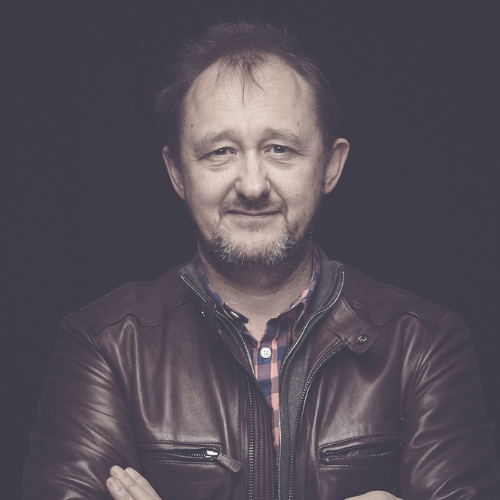
Andrew Upton
Andrew Upton is a Sydney-born writer, director and producer whose career spans theatre, film, television and audio. From 2008 to 2012, Upton was Co-Artistic Director and Co-CEO of Sydney Theatre Company alongside Cate Blanchett, before serving as sole Artistic Director from 2013 to 2015. During this period, Sydney Theatre Company expanded its national and international touring profile and undertook the landmark Greening the Wharf sustainability program. He has written for London’s National Theatre and Broadway. He is currently a principal of Dirty Films and co-creator of Audible’s climate podcast Climate of Change. His debut novel Krank Fuss was released in 2026.